4.9 Google Rating

How Long Does an AC Last in Dallas? (And How to Find Your Unit’s “Birth Date”)

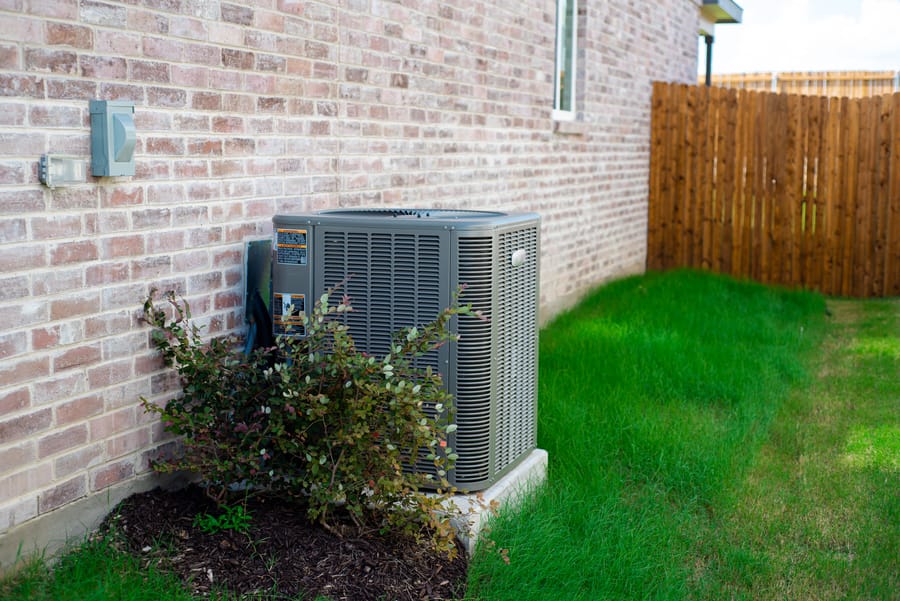
In the Dallas-Fort Worth metroplex, our air conditioners are not just appliances. They are survival equipment. From the first spike of heat in April to the grueling triple-digit stretches of August, we rely on these systems to keep our homes habitable. But because we ask so much of them, they do not last forever.
If you are a Dallas homeowner, you might be wondering how many more summers your current unit has left in the tank. At Moss Heating, Cooling & Plumbing, we believe that knowledge is power. Understanding the lifespan of your system and knowing exactly how old it is can help you plan for the future and avoid a middle-of-the-night emergency in July.
In this guide, we will break down the local factors that affect AC longevity in North Texas and show you how to play detective to find your unit’s true age.
The DFW Heat Island and Your AC
You may have read online that the national average lifespan for a central air conditioner is fifteen to twenty years. While that might be true in cooler parts of the country, Dallas is a different story. In our region, the local environment can shave two to three years off those national averages.
The Urban Heat Island Effect
Dallas is a massive concrete jungle. The asphalt roads, parking lots, and building materials in the DFW area absorb and retain heat far more than rural surroundings. This creates an urban heat island effect, where temperatures in the city can be several degrees hotter than in the outskirts. For your AC, this means it has to work much harder to reject heat from your home into an already scorching outdoor environment.
Humidity and Corrosion
North Texas is also subject to high humidity levels, especially during our stormy springs. This moisture, combined with local pollutants and dust, creates a corrosive environment for the delicate aluminum and copper coils inside your unit. Over time, this leads to microscopic leaks and mechanical strain that prematurely age your system. In Dallas, a well-maintained unit typically lasts twelve to fifteen years.
The Serial Number Cheat Sheet: Finding Your Unit’s Birth Date
If you did not live in your home when the current AC was installed, you might not know its age. Fortunately, every unit has a birth certificate in the form of a data plate. This is the metal sticker located on the side of your outdoor condenser.
To find the age, look for the serial number. Most manufacturers hide the manufacture date within this string of characters. Here is how to decode the most common brands found in Dallas:
-
Carrier, Bryant, and Payne: These brands are easy to decode. Look at the first four digits of the serial number. The first two represent the week of the year, and the second two represent the year. For example, a serial number starting with 1218 was manufactured in the 12th week of 2018.
-
Lennox: Most Lennox units use the first four digits. The first two are the numerical code for the plant, and the next two are the year. If the serial starts with 5815, it was likely built in 2015.
-
Trane and American Standard: These brands often use a letter code or a simple year-first format. In many modern units, the first digit of the serial number is the year. A serial starting with 7 means 2017. Older units may have the date printed explicitly in a MM/YYYY format.
-
Rheem and Ruud: Look for the first four digits after a letter. For example, in the serial number 1114F3210, the 11 represents the 11th week, and the 14 represents 2014.
-
Goodman and Amana: The first two digits are the year, and the second two are the month. A serial starting with 1905 was born in May 2019.
A Dallas Reality Check
It is easy to lose track of time when your AC is working quietly in the background. Sometimes a little local perspective helps put things into focus.
Is your unit older than the 2021 Cowboys season? It might be time for a check-up.
If your air conditioner was installed before Dak Prescott signed his big 2021 contract extension, it has already survived four of the most brutal Texas summers on record. Systems of this age in the Dallas heat are entering their middle-aged phase. This is the point where internal components like capacitors and fan motors start to show significant wear.
Factors That Can Extend (or Shorten) the Clock
While the Dallas heat is a constant, there are variables you can control to ensure your unit hits the fifteen-year mark rather than failing at ten.
Proper Sizing
Many homes in Dallas have units that are either too large or too small. An oversized unit will short-cycle, turning on and off constantly, which wears out the compressor. An undersized unit will run all day without ever reaching the set temperature. Both scenarios lead to an early grave for the equipment.
Maintenance Consistency
In the DFW area, a seasonal tune-up is non-negotiable. Because of our heavy pollen and dust, outdoor coils can become insulated by a layer of grime. This forces the unit to run hotter and under higher pressure. A professional cleaning and electrical check twice a year can add years to your system’s life.
Ductwork Integrity
If your ducts are leaking air into your attic, your AC is effectively trying to cool the entire city of Dallas. This extra load causes the system to run significantly longer cycles than necessary. Ensuring your attic insulation is sufficient and your ducts are sealed is one of the best ways to protect your AC investment.
Planning for Your Next Move
Knowing the age of your AC is the first step in responsible homeownership in North Texas. If your unit is approaching that twelve-to-fifteen-year window, it does not necessarily mean it will fail tomorrow, but it does mean you should be prepared. Modern systems are significantly more efficient than those built a decade ago, often saving Dallas homeowners thirty percent or more on their summer electric bills.
At Moss Heating, Cooling & Plumbing, we pride ourselves on giving our neighbors honest, expert advice. We don’t want you to be surprised by a breakdown when the heat index hits 110 degrees.
Contact Moss Heating, Cooling & Plumbing today to schedule a professional age and health assessment of your system so you can stay cool no matter what the Dallas weather has in store.
Recent News
Why Dallas Homeowners Are Switching to Whole-Home Air Purification

What Southlake Homeowners Should Know About Whole-Home Water Filtration

Why Some Colleyville Homes Feel Dustier at the End of Summer
We Look Forward To Hearing From You.
